 History of Mountain Biking
.
Mountain biking started to evolve in the late 1960s and early 1970s. At the time, there was no such thing as a
mountain bicycle. The earliest ancestors of modern
mountain bikes were based around frames from road cruisers such as those made by Schwinn. Riders used balloon tired beach cruisers and modified them with gears and motocross style handlebars. They would bomb (ride fast) down
mountain fireroads. The sport originated in California
It wasn't until the late 1970s and early 1980s that road bicycle companies started to manufacture mountain bicycles using high tech light weight materials. Gary Fisher is normally credited with introducing the first purpose-built mountain bike in 1979. The designs were basically road bicycle frames with a wider frame and fork to allow for a wider tire. The handlebars were also different in that they were a straight handlebar, rather than the low curved handlebars that are typically installed on road racing bicycles. Also, some of the parts on early production mountain bicycles were taken from the BMX bicycle. The first mass produced mountain bikes were produced by Specialized and had 18 gears.
Up until recently, mountain bicycles had road bicycle style frames and geometry. With mountain bicycling becoming more main stream and thus more aggressive in riding styles, newer stronger and better designed frames are coming out with a geometry designed for much more aggressive riding such as riding over obstacles like logs, rocks, and man made wooden bridges and ramps. Also, many riders are now jumping on mountain bicycles and taking on a more BMX style of riding. Newer mountain bikes have either 24 or 27 speeds. Three gears in the front and 8 or 9 gears at the rear wheel.
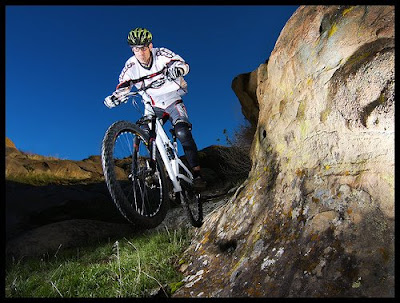
Many newer mountain bikes have a full suspension design. In the past, mountain bikes had a rigid frame and a rigid fork. In the mid 90's mountain bikes started to have a front suspension fork. This made riding on rough terrain easier on a riders arms. The first suspension forks has about 1 1/2 to 2 inches of suspension travel. Soon after, some frame designers came out with a suspension frame which gave riders a smoother ride all around. Early suspension frames were heavy and bounced up and down while a rider pedaled. This took a lot of power out of a riders pedal stoke, especially during climbs up steep hills. Newer suspension frame and fork designs have improved the weight, amount of suspension travel, and feel. Many lock out the rear suspension while the rider is pedaling hard or climbing. Most suspension frames and forks have at least 4 inches of suspension travel. More aggressive suspension frames and forks made for downhill racing and freeriding have as much as 8 or 9 inches of suspension travel. Many riders still prefer to ride a hardtail frame (bicycle without a rear suspension), but almost all mountain bicycle riders use a suspension fork.